- Gleneagles Medical Centre 6 Napier Road, #09-19, Singapore 258499

We strive to help you manage urogynaecologic symptoms so you can get back to living your best life. Book consultation with Dr Arthur Tseng now!
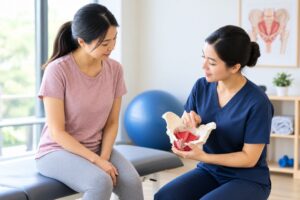
Pelvic floor physiotherapy is a course of guided exercises and bladder habits that retrains the muscles supporting your bladder, womb and bowel. At the first session, a physiotherapist asks about your symptoms, checks how well you can squeeze and relax these muscles (often with a gentle internal check, only with your consent), and gives you a home exercise programme. Most women attend a series of sessions over about three months.
The pelvic floor is a sling of muscles at the base of your pelvis, running from the pubic bone at the front to the tailbone at the back. It holds up your bladder, womb and bowel and helps keep the openings closed until you choose to go to the toilet.
Like any muscle, it can become weak, stretched or too tight. Pregnancy, childbirth, menopause, long-term straining and heavy lifting are common reasons. When it is not working well, you may leak urine, feel heaviness in the vagina, or struggle to control wind.
It helps women whose symptoms come from pelvic floor muscles that are weak, poorly coordinated or overactive. A doctor often suggests it as part of a wider treatment plan.
It is commonly used for:
The first session is an assessment. It usually lasts longer than follow-up visits and follows a clear order.
You can ask for a chaperone, ask questions throughout, and stop at any point.
Treatment centres on exercises you do at home every day, with regular sessions to check your technique and move you forward. The mix depends on your symptoms.
Approach | What it involves | Often used for |
|---|---|---|
Pelvic floor muscle training | Squeezes that build both strength (longer holds) and quick reactions (fast squeezes) | Leaks with coughing, mild prolapse |
Relaxation training | Learning to fully let go of the muscles | Pain, tightness, trouble emptying |
Biofeedback | A small sensor shows your muscle activity on a screen so you can see what you are doing | Women unsure if they are squeezing correctly |
Electrical stimulation | A gentle current helps very weak muscles contract | Muscles that are too weak to squeeze well at first |
Bladder training | Slowly lengthening the time between toilet visits | Urgency and frequency |
The “knack” | Squeezing just before you cough, sneeze or lift | Leaks with exertion |
Lifestyle advice | Fluids, caffeine, constipation, lifting and weight | Most pelvic floor problems |
It varies, but most programmes run over about three months. Muscles take weeks to strengthen, so early sessions may be one or two weeks apart and then spaced out as you improve.
The work you do at home matters most. A few minutes of focused exercises, spread across the day, tends to work better than one long session. Many women notice fewer leaks or less heaviness within a few weeks, with further gains over the following months. Results vary from person to person.
It should not hurt. The internal check can feel awkward or unfamiliar, but it is gentle. If you have pain with sex or tight muscles, the physiotherapist will go slowly and may start with external work only.
Some muscle tiredness after exercises is normal in the beginning, just like with any new workout.
See a doctor first if you have bladder, bowel or pelvic symptoms that have not been checked before. Some problems, such as infection, a significant prolapse or difficulty emptying, need medical assessment alongside or before commencing physiotherapy.
Book a consultation if you:
A urogynaecologist can examine you, explain the cause and discuss whether physiotherapy, other treatment, or a combination is right for you. Contact the clinic to arrange a visit.
You can see some physiotherapists directly, but a doctor’s assessment first helps rule out other causes and makes sure physiotherapy suits your problem. Some insurance plans also need a doctor’s referral, so check with your insurer.
You can, and many women do. Studies of supervised programmes show better results than self-guided training regimes, largely because many women squeeze the wrong muscles or push down instead of lifting. A few guided sessions can make home practice much more effective.
Yes. Pelvic floor exercises are generally encouraged during pregnancy. Tell the physiotherapist you are pregnant so they can adjust the assessment and positions and tailor a regime suited to pregnancy needs.
For mild to moderate prolapse, it can ease symptoms and may be enough for some women. For more advanced prolapse, it is often used alongside a support device or before and after surgery. The article on living with pelvic organ prolapse covers day-to-day management.
Gentle pelvic floor squeezes can usually be started almost immediately after a vaginal birth if the patient is well. A formal assessment is often done after your postnatal check, around six weeks.
This article is for general information only and is not a substitute for medical advice. Please consult a qualified doctor in Singapore for advice about your own situation.
Dr Tseng's expertise covers urinary incontinence and pelvic organ prolapse, apart from that, his particular interest lies in the holistic management of Overactive Bladder Syndrome and other functional bladder conditions. With many years of experience in this field, he is committed to providing patients